What Are the Different Types of Golf Courses? A Complete Guide

Golf courses, like most things, are not all cut from the same cloth. Their design is significantly influenced by the indigenous terrain and ecosystem. While you might not be behind the design, adapting your gameplay to fit different types of golf courses can give you a competitive edge. In the following article, we will guide you through a diverse landscape of golf courses, highlighting their common features and mentioning some renowned examples. Understanding the different types of golf courses is genuinely useful, whether you’re planning your next golf holiday, watching a tournament on TV, or simply trying to pick the right course for your skill level.
This guide covers all the major types: links, parkland, heathland, desert, mountain, championship, par-3, and executive courses and how each one plays, and which golfers tend to enjoy them most.
Different Types of Golf Courses
Links Course
Links course
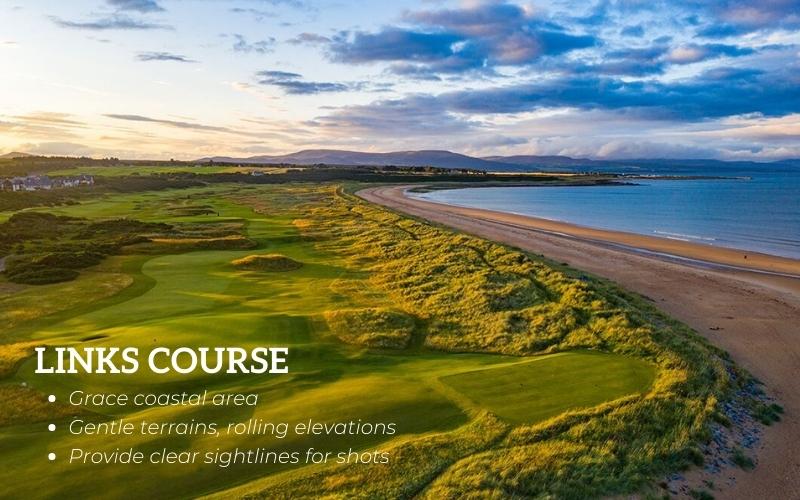
Links golf is where the game started. The word “links” comes from the Old English “hlinc,” meaning rising ground or ridge, and these courses trace back to 15th-century Scotland — the coastal strips of sandy ground between the sea and farmland that were too windswept for crops but perfect for hitting a ball around.
Today, links courses are still predominantly coastal. The terrain is naturally undulating, with firm ground that lets the ball run and roll in ways that catch out players used to more manicured layouts. There are no trees to block the wind, which means weather is a live factor on every hole, not just an inconvenience. Deep, steep-sided bunkers — some of which you simply cannot reach the green from — replace the water features you’d find on parkland layouts. The rough can be brutal. A ball that drifts offline doesn’t just find the rough; it finds knee-high fescue or dense gorse.
Playing well on a links course requires a different mentality. Bump-and-run shots matter. Ground game matters. Shot selection off the tee matters more than distance. Golfers who grip it and rip it and expect to stop the ball on a dime with a wedge will struggle until they adjust.
Well-known links courses include:
- Old Course at St. Andrews, Scotland — the original
- Royal County Down, Northern Ireland
- Royal St. George’s, England
- Ballybunion Golf Club, Ireland
- Pebble Beach, California
Parkland Course

Parkland course
Parkland courses are inland, lush, and generally what most recreational golfers around the world play on week to week. Named for their park-like feel, these layouts are defined by tree-lined fairways, manicured turf, water features, and carefully sculpted bunkers. Augusta National is the most famous example.
The key difference from links golf is control. Parkland courses don’t leave as much to the unpredictability of weather or natural terrain. Fairways are soft enough that approach shots hold their line. Water hazards are designed by architects rather than placed by geography. That level of curation makes them more visually consistent but also demands a different skill set — accuracy through tree corridors, judging distances to well-protected greens, managing the pace of bentgrass or Bermudagrass putting surfaces.
They’re also more forgiving in some ways and more punishing in others. Hitting into a water hazard is far more costly than drifting onto a links rough. But a calm day on a parkland course removes the variable of wind entirely, which is either a relief or a disappointment depending on your perspective.
Parkland courses are genuinely accessible for golfers at all levels, which is partly why they’re the dominant course type globally. Notable examples include:
- Augusta National Golf Club, Georgia, USA
- Wentworth Club, England
- Mission Hills Golf Club, Shenzhen, China
- Le Golf National, France (host of the Ryder Cup in 2018)
If you’re planning a Vietnam golf holiday or anywhere in tropical Asia, most courses you encounter will be parkland-style, adapted to the lush local landscape.
Heathland Course
Healthland course
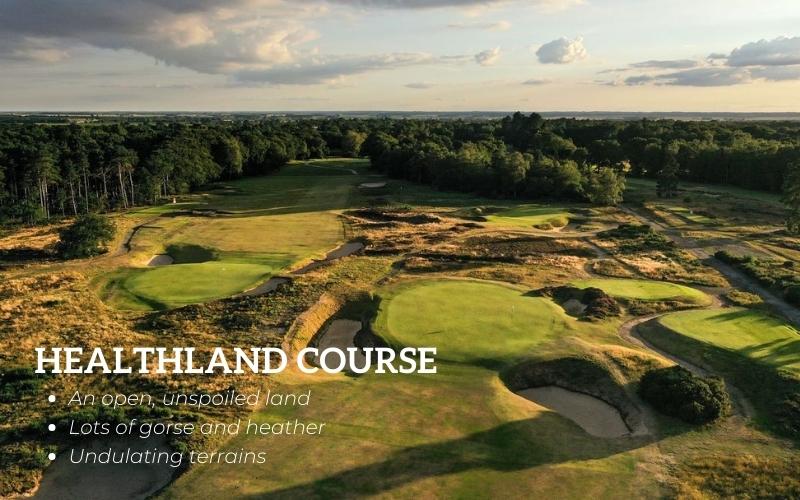
Heathland courses occupy an interesting middle ground. They’re inland like parkland courses but feel much more open and natural, with a texture closer to links golf. Located mainly in Britain — across Surrey, Berkshire, and similar counties. These courses sit on sandy, free-draining soil covered with heather, gorse, and bracken rather than lush grass.
The design aesthetic reflects the terrain: open fairways, natural undulations, and fewer artificially sculpted features. Over time, many heathland courses have grown more tree coverage (especially Scots pines), but the best examples maintain that open, windswept quality. When the heather blooms in late summer, the courses turn a deep purple that’s genuinely worth seeing regardless of how your round is going.
The key distinction from parkland: heathland courses tend to have firmer, faster conditions and less tree density. The main hazards are natural — heather rough, gorse bushes that eat golf balls, and sandy soil that produces unpredictable bounces. Compared to links, they’re more sheltered from coastal wind but still demand precise shot-making.
Top heathland courses to know:
- Sunningdale Golf Club (Old and New Courses), England
- Walton Heath Golf Club, England
- Woking Golf Club, England
- Alwoodley Golf Club, Leeds, England
- Royal Melbourne Golf Club (East Course), Australia
Desert Course
Desert course
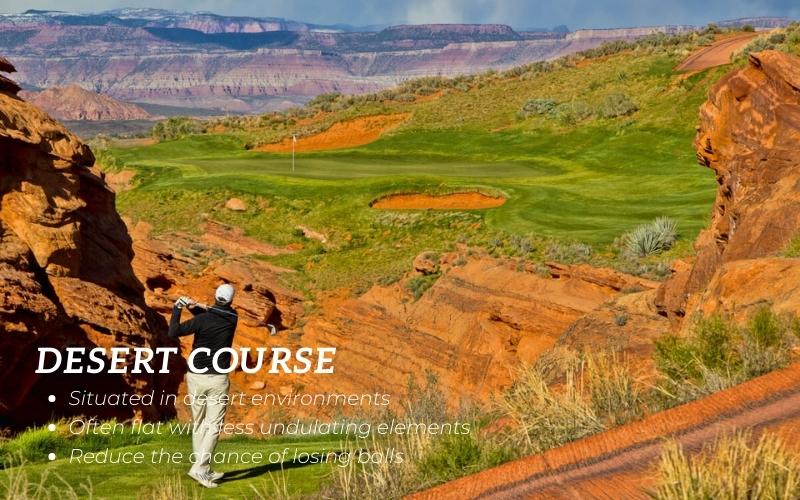
Desert golf is a genuinely different experience. The contrast between irrigated turf and surrounding arid landscape — sandy rock, cacti, golden dunes — creates a visual drama you don’t get anywhere else. These courses aren’t simply located near a desert; they’re woven into it. Stray off the fairway on a desert course and you’re dealing with hard-packed sand, rocks, and often unplayable lies.
That’s also the strategic challenge. Desert courses tend to have narrower playing corridors than parkland layouts. The premium on accuracy is real — a pulled drive on a typical parkland course might find rough and leave a recovery shot; the same drive on a desert course might find an unplayable lie among rocks. Getting around a desert course cleanly requires discipline off the tee, regardless of how tempting the yardage looks.
On the plus side: desert courses are almost always playable. The sunny, dry climate means no waterlogged fairways, no soft greens, no cancelled rounds due to weather. Early mornings in particular offer an almost meditative quality, with low light across the sand and complete quiet.
Notable desert courses include:
- TPC Scottsdale, Arizona, USA (home of the Phoenix Open)
- Shadow Creek, Nevada, USA
- Emirates Golf Club – Majlis Course, Dubai, UAE
- Al Ghazal Golf Club, Abu Dhabi, UAE
- Quivira Golf Club, Los Cabos, Mexico
For golfers interested in desert golf experiences in the UAE, GolfLux offers tailored Dubai golf packages that include tee times at the region’s top courses.
Mountain course
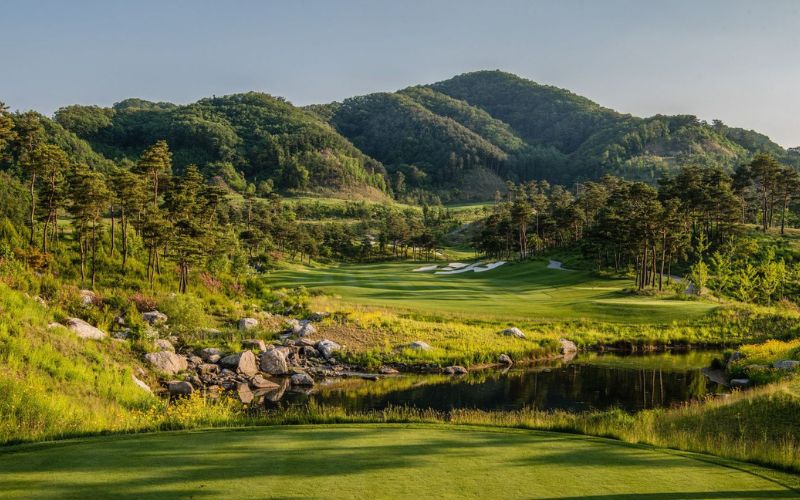
Whistling Rock Country Club (South Korea)
Mountain courses make every shot feel consequential. Set against dramatic elevation changes, peaks, and valley views, these layouts turn a round of golf into something closer to an adventure. Tee boxes can sit hundreds of metres above the fairway below. Approach shots play entirely differently when the green is elevated or the ball is above your feet on a hillside lie.
The practical challenges stack up quickly. Uphill holes play longer than their yardage suggests; downhill holes play shorter and often require more precision with trajectory to hold greens. Uneven lies are the norm, not the exception. At altitude, the ball travels further in thinner air, which sounds advantageous until you start overclubbing into a green with a steep drop behind it.
Golfers who find flat parkland courses a bit routine tend to love mountain golf. The variety of shots required, the scenery, and the physical setting make for rounds that are hard to forget, even when the scorecard is not particularly flattering.
Well-regarded mountain courses:
- Whistling Rock Country Club, South Korea
- Jade Dragon Snow Mountain Golf Club, Lijiang, China
- The Links at Fancourt, South Africa
- Crans-sur-Sierre Golf Club, Switzerland
GolfLux’s Fancourt Hotel Stay & Play package is a good starting point for golfers looking to experience mountain-influenced layouts in the spectacular Western Cape landscape.
Championship Course

Championship course
A championship course isn’t a design style, it’s a status. The term gets used in two ways. At a resort or club with multiple 18-hole layouts, the “championship course” is typically the harder, more prestigious of the two, maintained to the highest standard and carrying a premium green fee. At a single-course venue, the designation often comes from having hosted significant tournaments — club championships, regional competitions, or professional events.
There are no rigid criteria. Whether a course earns the “championship” label often comes down to reputation and usage over time, not a formal certification. At a resort where the fees are identical across two courses, a quick question to the pro shop — “which one hosts your club championship?” — will usually tell you which is considered the premier layout.
For visiting golfers at multi-course venues, the championship course is almost always worth the extra investment if there is one.
Par-3 Course
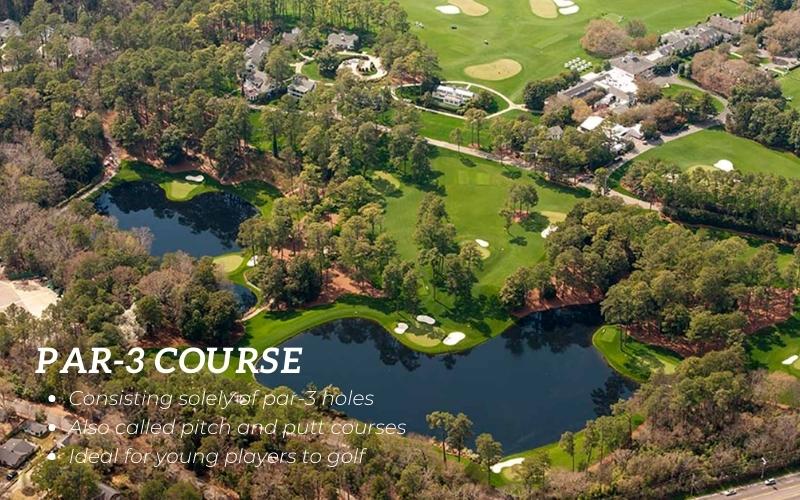
Par-3 Course
A par-3 course consists entirely (or almost entirely) of par-3 holes. No drivers required. Rounds typically take under two hours. Scores are lower and the atmosphere is more relaxed than a full-length course, which makes these layouts genuinely useful for three specific groups: complete beginners learning the basics, younger players developing a feel for the game, and experienced golfers who want a focused short-game session without committing to a full 18-hole round.
The term “pitch and putt” signifies courses with holes short enough that a simple pitch shot is all that’s needed to navigate them. The nuanced difference between the two is that pitch and putt courses might feature a par-4 hole here or there. Neither format should be dismissed as “easy golf” — some of the world’s most creative and technically demanding holes are par-3s, and playing under par on a well-designed short course is harder than it sounds.
>>> If you’re new to the sport and want a list of standout options, GolfLux has compiled the Best Par-3 Courses in the world as a useful starting point..
Executive Course

Executive Course
An executive course is a step up from a par-3 course in terms of variety. These layouts still feature a high proportion of par-3 holes, but they include a handful of par-4s — enough to pull out the driver two or three times per round. Most run to a full 18 holes.
The name has corporate origins. Several decades ago, companies built these shorter courses for senior executives who could fit in a quick morning round before work. That exclusivity is long gone; executive courses are now generally open to the public and serve much the same role as par-3 courses — an accessible, time-efficient round that’s still long enough to feel complete.
They work well for beginners and for mid-handicappers who want to work on specific parts of their game without the time commitment of a full round.
Which type of golf course suits you?
The honest answer is that most golfers don’t stick to one type, the variety is part of what makes the game interesting over a lifetime. That said, a rough guide based on experience level:
- Beginners and casual players: Parkland courses, executive courses, and par-3 layouts offer the most forgiving introduction. Conditions are consistent, sightlines are generally clear, and the atmosphere is accessible.
- Intermediate players: Heathland and desert courses add more natural hazard challenges without the full unpredictability of links weather. They reward precise shot-making and course management.
- Experienced and low-handicap players: Links courses and mountain courses offer the most strategic depth. Variable conditions, firm ground, and terrain-driven challenges test every part of the game.
On budget and travel: Parkland courses are the most widely distributed and typically the most affordable. Links courses, heathland courses, and mountain courses often require dedicated travel, but that’s part of the appeal.
If you’re putting together a golf trip in Asia and want local expertise on course selection, the GolfLux team is available to help you plan around your skill level, preferred style of course, and travel dates. Get in touch.
Conclusion
Golf courses are as varied as the landscapes they sit on, and that variety is genuinely one of the sport’s greatest strengths. Whether you’re drawn to the raw, wind-battered challenge of a links layout, the polished fairways of a parkland course, or the dramatic elevation of a mountain track, each type offers something the others don’t. No single course type is objectively better — it comes down to what you enjoy, how you play, and where you want to travel.
The more types of courses you play, the better your overall game tends to get. Links golf forces you to think creatively with ground shots. Desert golf sharpens your accuracy off the tee. Mountain golf teaches you to play from uneven lies and adjust for elevation. Each environment adds something to your toolkit that a comfortable home course simply won’t.
If you’re ready to explore a new type of course on your next golf trip across Asia and beyond, GolfLux can help you find the right fit — whether that’s a coastal links experience, a tropical parkland layout, or something in between.
Read more:
- Top 15 Toughest Golf Courses in the World
- Top 8 Famous Golf Bunkers in the World
- Which Country Has the Most Golf Courses in the World?
FAQ
-
What is the difference between a parkland and a heathland course?
Both are inland, but the feel is quite different. Parkland courses are lush, manicured, and often feature tree-lined fairways with water hazards. Heathland courses sit on sandier, firmer ground with native vegetation like heather and gorse. Heathland layouts are more open and natural-looking; parkland courses tend to be more polished and sculpted. Think of heathland as the wilder, more rustic cousin.
-
Are par-3 courses suitable for experienced golfers?
Yes. Par-3 courses are useful for golfers at any level who want to work on short-game skills, iron accuracy, and putting without committing to a full round. Many serious golfers use them as focused practice rounds. They’re also a sensible warm-up option the day before a competitive round on a full-length course.
-
What makes a desert golf course different to play?
The main difference is the penalty for missing the fairway. On most parkland or heathland courses, an errant shot finds rough or trees. On a desert course, it may find unplayable rock or sand. This demands greater accuracy off the tee and makes course management more important than raw distance. Desert courses also tend to be playable year-round in ways that weather-affected links and mountain courses are not.
-
Which types of golf courses are used for professional tournaments?
Most professional events are played on either links or parkland courses. Links golf dominates the European Tour and the Open Championship. US Tour events are predominantly played on parkland layouts, though some courses have heathland or hybrid characteristics. Championship-calibre mountain and desert courses do host professional events occasionally, though they are less common on the major tours.