Pakse is not a golf destination in the same category as Bangkok, Da Nang, or even Vientiane. There is one main golf course here, and most golfers visit southern Laos for the landscape and slower pace first, with golf added into the itinerary rather than driving the entire trip. That is also why Pakse works. The city sits at the meeting point of the Mekong and Xe Don rivers in Champasak Province, close to the Bolaven Plateau, Wat Phou UNESCO World Heritage Site, and the 4,000 Islands region. Golf becomes part of a wider southern Laos journey rather than a standalone golf circuit.
For golfers already traveling through Laos or northeastern Thailand, Pakse works especially well as a short extension with one or two relaxed rounds, waterfall excursions, coffee plantation visits, and river scenery. The atmosphere is noticeably quieter than the larger Southeast Asian golf hubs. Traffic is lighter, schedules are slower, and most attractions are within manageable driving distance. Couples, small groups, and golfers building a broader Laos itinerary connecting Vientiane, Luang Prabang, and southern Laos usually get the most out of a Pakse golf trip.
The golf setup itself is straightforward. Pakse Golf Club sits only a few kilometers from the city center and gives the destination a proper championship-length course in a region where golf infrastructure remains limited. That simplicity is part of the appeal. You are not spending hours moving between resorts or deciding among ten different courses. One round in the morning, a waterfall or coffee plantation in the afternoon, dinner by the Mekong in the evening. Pakse is easy to organize once you understand what the destination is trying to be.
Golf course in Pakse
Pakse Golf Club
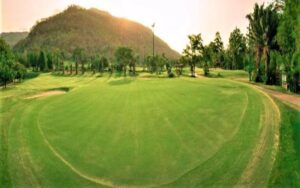
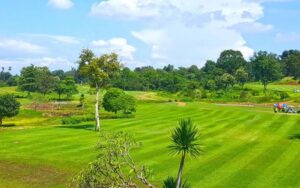
Pakse Golf Club is an 18-hole, par 72 course measuring 7,014 yards from the back tees, located around 3 kilometers from central Pakse. Public golf travel sources also list a slope rating of 128 from the blue tees. The course sits near the Xe Pian National Protected Area and uses relatively open terrain with water hazards, long fairways, and broad landing zones that make it approachable for visiting golfers while still long enough to challenge stronger players.
What separates Pakse Golf Club from many regional courses is the atmosphere around the round rather than dramatic resort infrastructure. Southern Laos is still lightly developed compared with neighboring Thailand or Vietnam, and the course reflects that environment. The fairways move through open tropical land with mountain views in the distance rather than dense residential development. Several holes feel exposed and warm during the middle of the day, which makes early morning tee times especially practical. Golfers who enjoy quiet courses without heavy resort traffic usually appreciate the pace here.
The location also makes the course easy to integrate into broader travel plans. Pakse Golf Club suits golfers combining golf with Bolaven Plateau touring, Wat Phou visits, or Mekong river travel toward Si Phan Don. It also works well as a golf stop for travelers crossing between Laos and Thailand through Ubon Ratchathani. Most visitors only need one round here, though stronger golfers on longer southern Laos itineraries sometimes play twice while using Pakse as a base.
Best time to play golf in Pakse
Southern Laos has a tropical climate with a distinct dry and wet season. Laos tourism sources generally describe November through February as the coolest and driest period, while May through September brings heavier rainfall across the south. Golf in Pakse is playable year-round, but the experience changes noticeably depending on the season.
November to February: This is the strongest overall season for a Pakse golf trip. Temperatures are more comfortable, humidity drops, and visibility across the surrounding countryside is generally clearer. Morning golf conditions are especially pleasant during December and January. This is also the best period for combining golf with Bolaven Plateau waterfall trips and Wat Phou sightseeing because the roads are easier to travel and outdoor touring is more comfortable.
March to May: This is the hotter season. Golf remains possible, but midday rounds can become physically demanding because the course has several exposed stretches with limited shade. Morning tee times are the sensible choice during these months. The upside is that tourism traffic remains lighter than the peak winter season.
June to September: The wet season changes the feel of the destination. Afternoon rain becomes common, though mornings are often playable before storms build later in the day. The countryside becomes greener and the waterfalls on the Bolaven Plateau are at their fullest during this period, which many travelers actually prefer visually. Golfers traveling in these months should leave more flexibility in the schedule. Avoid tightly packed itineraries with immediate transfers after rounds. Conditions can shift quickly during the afternoon, especially in July and August.
October: October sits between the wet and dry seasons and can work surprisingly well for golf in Pakse. The landscape still looks green from the rainy season, temperatures begin easing slightly, and tourism numbers remain manageable before the high season begins. For travelers wanting quieter conditions without peak-season pricing, this is often a practical compromise.
Pakse golf holidays and package tours
Pakse works best as a short two to four day golf extension rather than a long standalone golf holiday. Most itineraries center around one or two rounds at Pakse Golf Club combined with waterfall touring, UNESCO heritage sightseeing, or Mekong river travel further south.
The destination also connects naturally into broader Laos routes. Many travelers arrive from Vientiane or Luang Prabang by domestic flight, while others combine Pakse with northeastern Thailand via Ubon Ratchathani. Because distances between attractions are manageable, the programs are relatively easy to structure without constant hotel changes.
A standard Pakse golf package usually includes accommodation in the city center or near the Mekong riverfront, airport transfers, tee times, caddie arrangements, and private transport for sightseeing. Most travelers also add at least one non-golf excursion because southern Laos is better experienced as a mixed itinerary.
Travelers building longer Laos itineraries can also combine Pakse with Vientiane and Luang Prabang golf programs through GolfLux Laos golf holidays for custom routing options.
For couples and mixed-interest groups, Pakse is relatively easy to balance. One person can play golf while the other visits cafés, waterfalls, temples, or local markets without needing a separate long-distance excursion.
Golf with the Bolaven Plateau and Wat Phou
This is the combination that gives Pakse its identity. Very few golf destinations in Southeast Asia can combine a full-length golf course with UNESCO Khmer temple ruins, coffee plantations, and some of the region’s best waterfall landscapes within short driving distance of the same city.
Wat Phou, recognized as a UNESCO World Heritage Site, predates Angkor Wat and sits about 40 kilometers south of Pakse along the Mekong corridor. The Bolaven Plateau, meanwhile, is known for coffee production, cooler temperatures, and waterfalls such as Tad Fane and Tad Yuang. Those attractions give Pakse a stronger non-golf identity than the golf itself.
A practical itinerary is to arrive in Pakse, play golf on the first morning, then spend the afternoon along the Mekong riverfront before taking a Bolaven Plateau day trip the following day. Another workable structure is to visit Wat Phou first, stay overnight in Pakse, and finish the trip with a final morning round before departing.
Pakse Golf Club works particularly well for this style of travel because the course is close enough to the city that golfers do not lose an entire day to transfers. You can realistically finish a morning round, return to the hotel for lunch, and still have time for coffee plantation touring or a river dinner afterward.
That flexibility is the real selling point of golf in Pakse. The destination is not trying to compete with large-scale golf resort hubs. It works because golf fits naturally into a broader southern Laos travel experience.
Book tee times in Pakse
Booking tee times in Pakse is generally straightforward because the destination has only one primary course, but that also means your planning should be deliberate. If the course is hosting a local event or group booking, there are no nearby alternatives inside Pakse itself.
When arranging your Pakse golf trip, it helps to confirm:
- Preferred playing date
- Morning or afternoon tee time
- Club rental requirements
- Hotel and airport transfers
- Transportation for Bolaven Plateau or Wat Phou excursions
- Whether the golf round connects with onward travel to Si Phan Don or Thailand
Morning rounds are usually the better option throughout most of the year, particularly from March through September when afternoon heat or rain becomes more likely. It is also wise to leave buffer time between golf and long-distance transfers since southern Laos travel infrastructure moves at a slower pace than larger regional hubs.
For travelers building a broader Laos golf itinerary, Laos golf packages can combine Pakse with Vientiane and Luang Prabang into a single customized route.